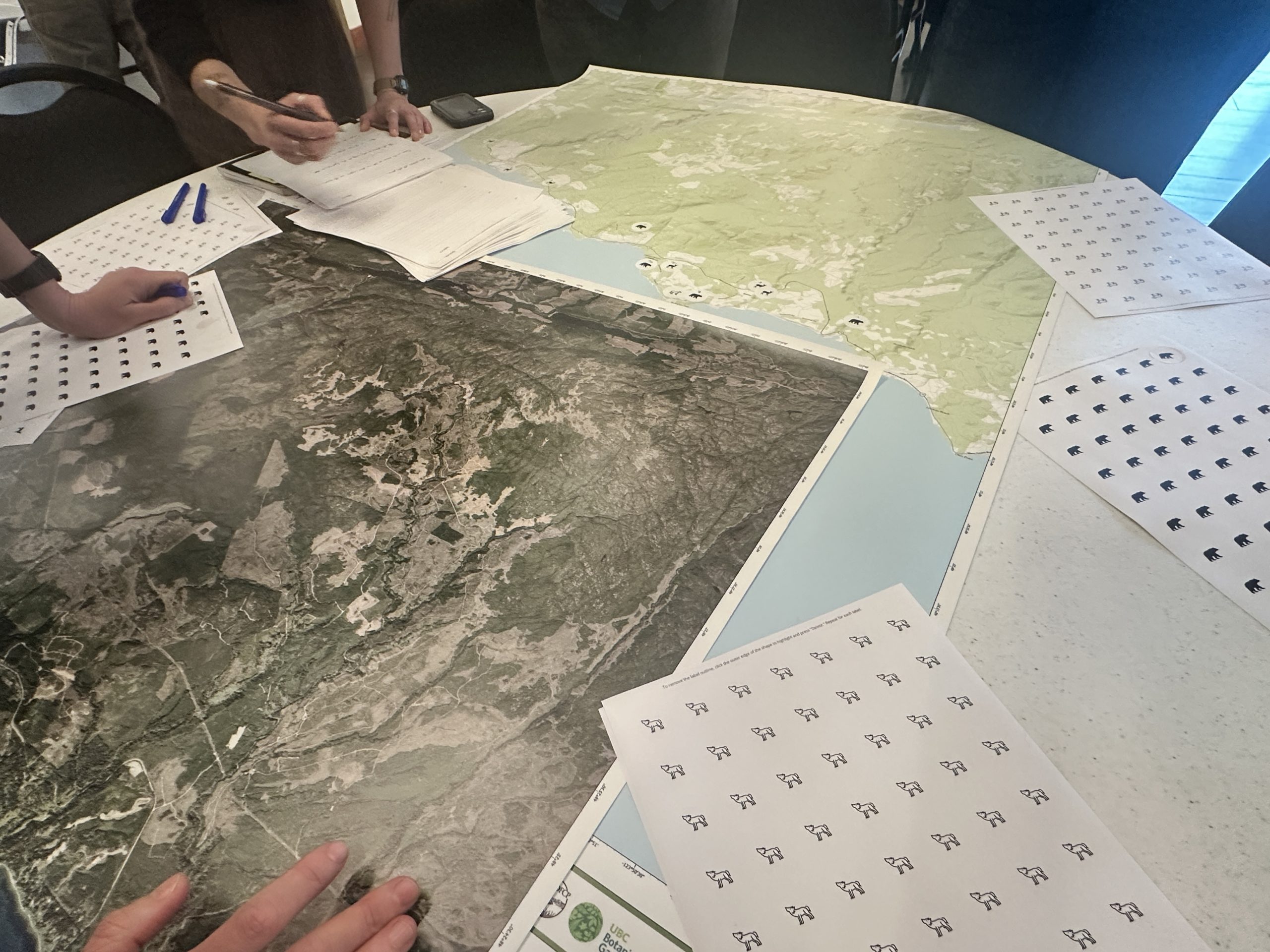
GOMPS was pleased to participate in the Southern Vancouver Island Wildlife Corridor Workshop on February 12, 2026, joining a growing network of community members, researchers, and organizations working to strengthen habitat connectivity across the region.
The day was full of thoughtful discussion, collaborative mapping, and shared insights—helping translate community knowledge into both physical and digital mapping outputs. We’re encouraged to see this work continue, with ongoing updates and opportunities emerging from this expanding network.
We look forward to contributing to future efforts that support ecological connectivity and the protection of Garry oak ecosystems across Southern Vancouver Island.
The dominant species in this area is Garry oak, and casual observations confirm that dozens of other species that co-evolved with this tree species are also present.
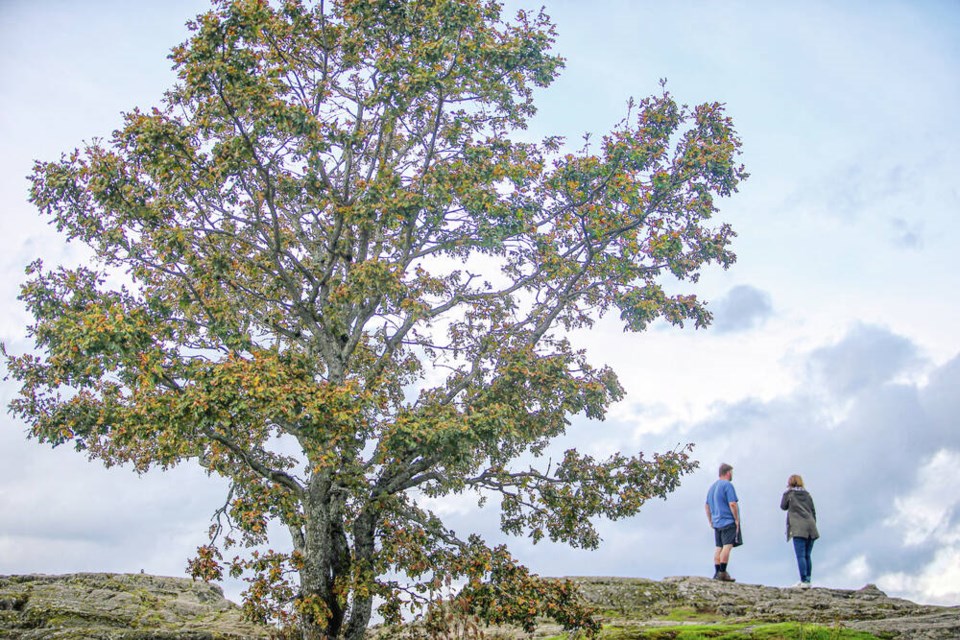
People stand atop Mt. Tolmie beside a large Garry oak tree. ADRIAN LAM, TIMES COLONIST
A commentary by a Saanich resident.
Buried on page 135 of Saanich’s Quadra-McKenzie Plan are clues of what is in store for present and future residents of Saanich.
Two words that can better connect our imaginations to this place, quicker than just about any other term in the plan, have been relegated to the Quadra-McKenzie Plan’s glossary: Garry oak.
If you’ve ever navigated the Quadra and McKenzie area, you’ll know you can wander in any direction and encounter truly unique woodlands and individual Garry oak trees blended into the built environment.
The dominant species in this area is Garry oak, and casual observations confirm that dozens of other species that co-evolved with this tree species are also present.
The critically endangered remnants of the kwetlal or Garry oak ecosystem exist in the Quadra and McKenzie area today in large part because of lək̓ʷəŋən and W̱SÁNEĆ stewardship.
In the 2010s, as pressure to bypass development practices that preserve trees and ecosystems intensified, Saanich residents could count on the consistent public support of Dean Murdock, then councillor, for the Garry oak ecosystem.
When Murdock was challenged in 2015 by residents pointing to flaws in Saanich’s bylaws associated with sensitive ecosystems, he shared, “I’m supportive of the intent [of the Environmental Development Permit Area].”
He provided further comments, noting, “It’s really designed to be a protective tool, so that in the event of a change in land use, redevelopment or rezoning, we’re protecting those areas.”
As Murdock, now the mayor, nears the end of his term, his philosophy on Garry oak ecosystems appears to have inverted.
The flawed maps implemented as the evidence-based instrument for implementing the EDPA bylaw still echo across the province today as a cautionary tale of environmental policy failure.
The scandal that emerged frustratingly exacerbated perceptions that ecosystems and urban development are oppositional forces. What followed the collapse of the EDPA was five years of technical review panels and multiple environmental consulting contracts.
After it was proposed by Coun. Zac de Vries, council endorsed the 3-30-300 urban forestry principle, which mandates that every citizen sees at least three trees from their home, that there is 30 per cent urban forest canopy in every land-use designation area and every home is no more than 300 metres from a high-quality green space.
In 2022, there was a last-minute tree-planting election campaign promise by Murdock. His comments in the Times Colonist that November committed to planting “100,000 trees by 2032 on public lands, boulevards and private properties.”
Saanich Parks, which has no authority to plant trees on private land and has received no funding to support increased public tree-planting capacity, is on track to achieve this goal 30 years late.
Murdock’s progress on this particular objective is similarly vexing as council’s meddling with its own 3-30-300 commitments.
After receiving widespread praise for its early adoption of the principle, the Urban Forest Strategy will strive to achieve the 30 per cent canopy threshold in 2064, with one caveat: Saanich Core has been removed from the primary growth land use designation area.
Whether 3-30-300 champion de Vries takes issue with this creative canopy-commitment workaround is ultimately moot. Saanich has no pathway to achieving canopy targets if they continue to defer funding and delay implementing the biodiversity and urban forest strategy recommendations.
Saanich is developing a new tree protection bylaw using urban forest canopy analysis that is nearly seven years old. This is a feature of council opting out of Urban Forest Strategy recommendations to update canopy analysis “at least every five years,” and prevents the ability for comparison with the 2019 canopy baseline.
This is important information to inform how current policies around land use development, climate change and the effectiveness of management approaches are working.
Upgraded canopy analysis would improve decision makers’ understanding of how the Quadra-McKenzie Plan is likely to alter existing canopy, and what management and policy interventions are necessary for urban forestry stewardship.
The voting majority of council, choosing to defer strategic plan recommendations, including updating the canopy analysis, and rushing to implement the Quadra McKenzie Plan, is not taking its responsibility as the steward of this critically endangered ecosystem seriously.
Accountability can be restored, but replacing the kwetlal food system/Garry oak ecosystem after it is removed, council and senior staff cannot.
Cori Lausen: 48 species listed as endangered federally aren’t recognized as species at risk in B.C. and thus don’t qualify for measures that could save their habitat from destruction or disturbance.
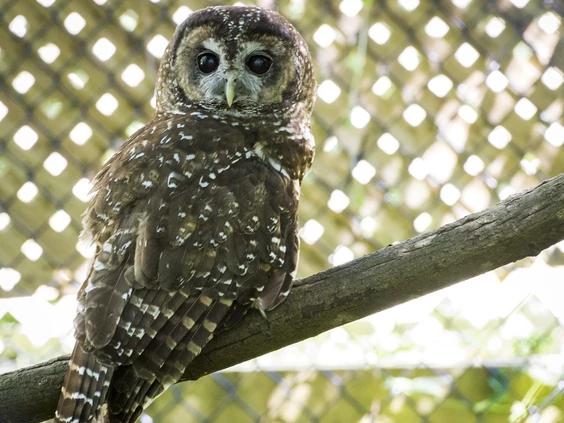
The spotted owl is B.C.’s most well-known, but far from only, example of how a species can be lost when habitat protection is ignored, writes Cori Lausen. PHOTO BY RIC ERNST /PNG
The B.C. government’s Look West strategy is to get four new mines (or expansion of current mines), three new natural gas projects and eight new renewable energy projects built in the next six years.
Article content
The same sense of urgency hasn’t been applied to protecting B.C.’s ever-increasing number of species at risk. Hundreds of species have been identified as threatened or endangered since 2006, yet it has been two full decades since the provincial government last updated B.C.’s Species at Risk list, often referred to as the Identified Wildlife list. Few protections exist for wildlife in B.C. that aren’t on this “Noah’s Ark” list.
This list falls under the Forest and Range Practices Act, and specifies which species are eligible for habitat protection measures during timber harvesting and grazing across the province.
though the province indicated several years ago that this list would be expanded to narrow the large gap between which species the province protects relative to which species are designated as endangered under the federal Species at Risk Act, it has yet to do so. A proposed expansion of the list was publicly reported well over a year ago, but the updated list has yet to receive approval.
Article content
Old or updated, though, the list continues to cover only a tiny subset of the species considered to be in trouble in this province. Of the greater than 1,600 species considered at risk in B.C., only 85 are currently included on the B.C. government’s Species at Risk list.
Article content
Three bat species illustrate the consequences of this delay. Two were listed as federally endangered in 2014, and a third, the hoary bat, was assessed as endangered in 2023 after severe population declines linked to wind energy mortality. Bats play a critical role in controlling insect populations, including forest and agricultural pests, and their decline increases pressure on already stressed ecosystems. As a bat biologist, I see these impacts firsthand in population monitoring and habitat assessments across the province. Bats are just one example of important biodiversity falling between the cracks in B.C.
t may come as a surprise that just because a species is recognized and legally listed by the Canadian government, that doesn’t mean its habitat is protected in B.C. or in any other province. In most cases, protection only applies to areas under federal jurisdiction, like in a national park. There are 48 species listed as endangered federally that aren’t currently recognized on B.C.’s Identified Wildlife list and thus don’t qualify for the protective measures that could save their habitat from destruction or disturbance.
Decades of conservation science show that habitat loss and degradation are the primary drivers of species decline, and that populations rarely recover without strong habitat protection. The spotted owl is B.C.’s most well-known, but far from only, example of how a species can be lost when habitat protection is ignored.
Article content
In 2017, the NDP government justified its decision not to proceed with a provincial law dedicated to species at risk by committing instead to develop a more comprehensive suite of tools to protect biodiversity in the province. While that approach could have merit, progress has been minimal and delayed. For example, in 2016, the province committed to a best management practices document to guide forestry operations in sustaining bat populations in the face of timber harvest. That document was drafted, but has yet to be finalized, let alone implemented, a decade later. Each year of delay makes effective protection more difficult and costly.
Expediting development at the cost of protecting biodiversity and natural areas represents a false economy. Bat-friendly forestry practices, for example, help sustain insect control services that support forest health and reduce management costs that will inevitably arise later. Forests need bats, and bats need forests for mutual sustainability. Weakening this relationship undermines the long-term resilience of ecosystems and the industries that rely on them.
Article content
The costs of continued delay aren’t abstract. Allowing species to slide toward extinction removes critical components from tightly interconnected ecosystems, reducing their capacity to recover.
Article content
While such short-sightedness may be baked into our political system, we can’t let it dictate the fate of our ecosystems and the biodiversity upon which they (and we) depend. If we throw species and their habitats overboard in our rush to develop resources, we will impoverish not just our province, but our world — decisions we make not just for us but for future generations.
Article content
Cori Lausen is director of bat conservation at the Wildlife Conservation Society Canada.
This webinar discusses the Action for Adaptation Biodiversity Atlas and toolkit, launching in early 2026.
Stephanie Woods, Program Manager at the CDFCP, discusses the importance of the Biodiversity Atlas and Toolkit.
Dionne Bunsha, the Climate and Conservation Engagement Coordinator at the UBC Botanical Garden, showcases the Action for Adaptation Website.
Kelly Chapman, ecologist and environmental planner, discusses the mapping layers in the atlas.
Marian McCoy, an ecologist, former Professional Agrologist and Policy Analyst with the provincial Ministry of Water, Land and Resource Stewardship, highlights the policy toolkit component of this project.
If you are concerned about Garry oak trees (and other mature trees too) please consult our links to the Tree Protection Bylawsin your municipality or electoral region.
As a resident, voter and tax payer you hold the power to help stop the decline of trees in your region. Get started by consulting with our FAQ page and learn more about protecting and caring for Garry oak trees.