Carollyne Yardley

  • The Quadra Overpass Garry Oak Planting: 30 Year Remeasurement, Sept 2025.

    The Quadra Overpass Garry Oak Planting: 30 Year Remeasurement, Sept 2025.

    By Jacklyn Jolicoeur and Ryan Senechal

    The Commonwealth Games Legacy Garry Oaks 

    This was a legacy Garry oak tree planting project to commemorate the 1994 Commonwealth Games.  Two members of GOMPS -Jean-Anne Whitman, landscape architect and Willie MacGillivray, together with the Ministry of Transportation and Highways, the Provincial Capital Commission, Forestry Canada and a group of community volunteers, participated in this project.    

    Planting Technique and Seedling Source
    All of the planting techniques were arrived at through consultation with representatives of GOMPS, Forestry Canada and a project manager, Ms. Carol Jones, Professional Agrologist and Nursery operator in North Saanich at the time.  The intent was to use “the planting project to assess the growth and health of Garry oak seedlings and to evaluate the use of seedling protection tubes.”

    The site preparation included stripping, burying, and tilling the sod, blanketing the site with landscape cloth, and then covering it with bark mulch to keep weeds back.  As such, the site approximates a near-natural, non-irrigated habitat. 

    The Garry oak seedlings were “plugs” grown the year before (1993) by Rob Hagel of the Pacific Forestry Centre.  On February 19, 1994, volunteers planted 211 seedlings by inserting them into holes dug through the mulch and cloth with a tablet of Bestgro fertilizer placed into the bottom of each hole.  Approximately 80% of the seedlings were shielded with protective tubes. 
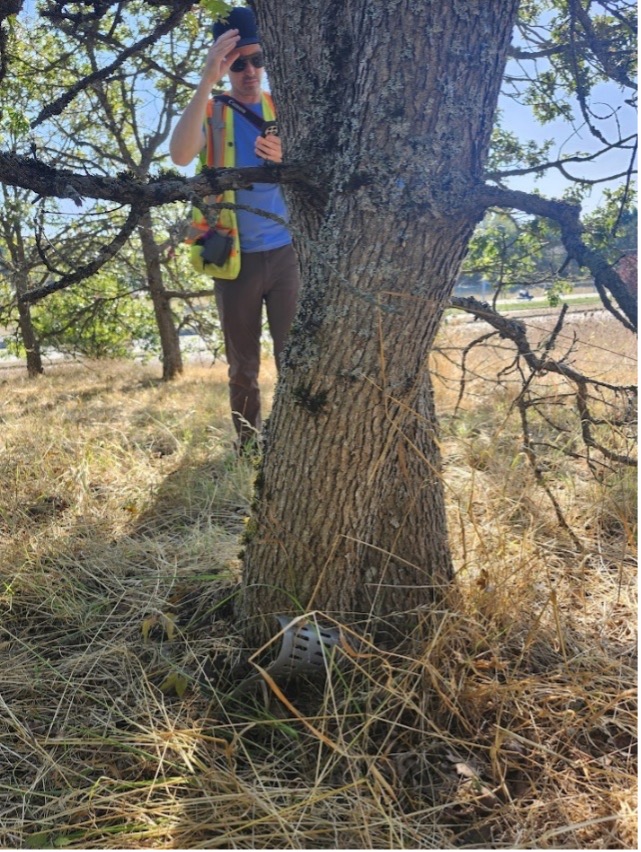
    Photo by Jacklyn Jolicoeur. The remains of an original protective tube can be seen at the base of the tree 

    Previous Inspections 
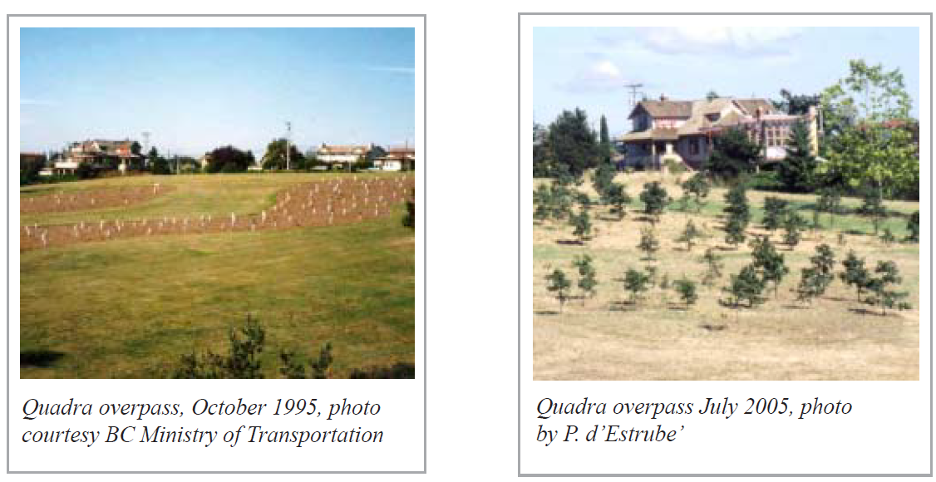
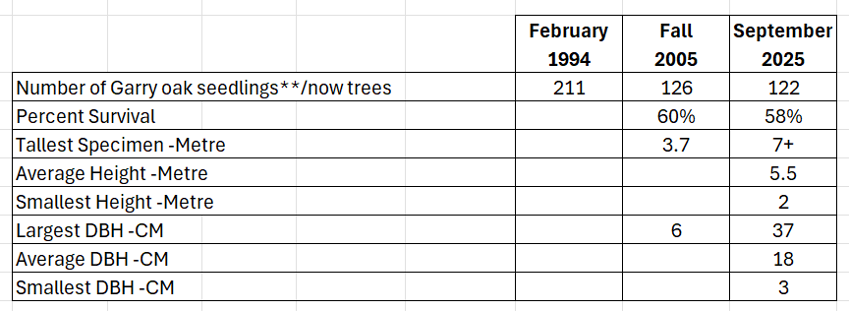
    The planting clusters were inspected during March of 1994, April of 1995, and in October 1995.  The writers do not have access to the records for these inspections.  In the fall of 2005, Dr Michael Meagher (retired forester and honorary member of GOMPS) recorded some key measurements and statistics for the planting clusters in the GOMPS newsletter (June 2006), which form the basis of a comparison of the Garry oak trees in 2005 and 2025 (see table below).
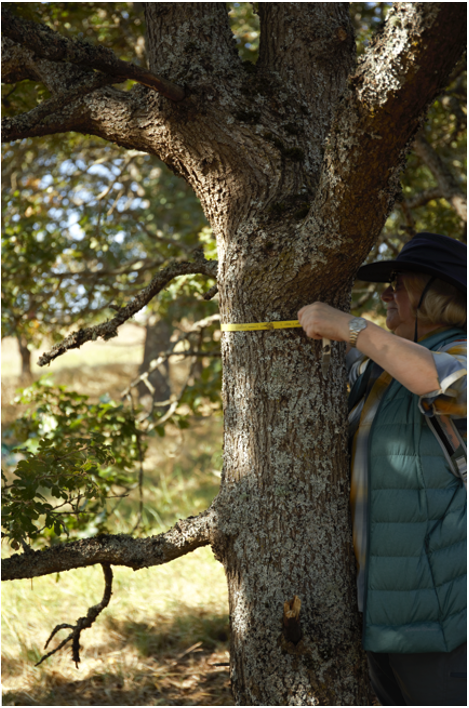
    Jacklyn is measuring the DBH – diameter at breast height.
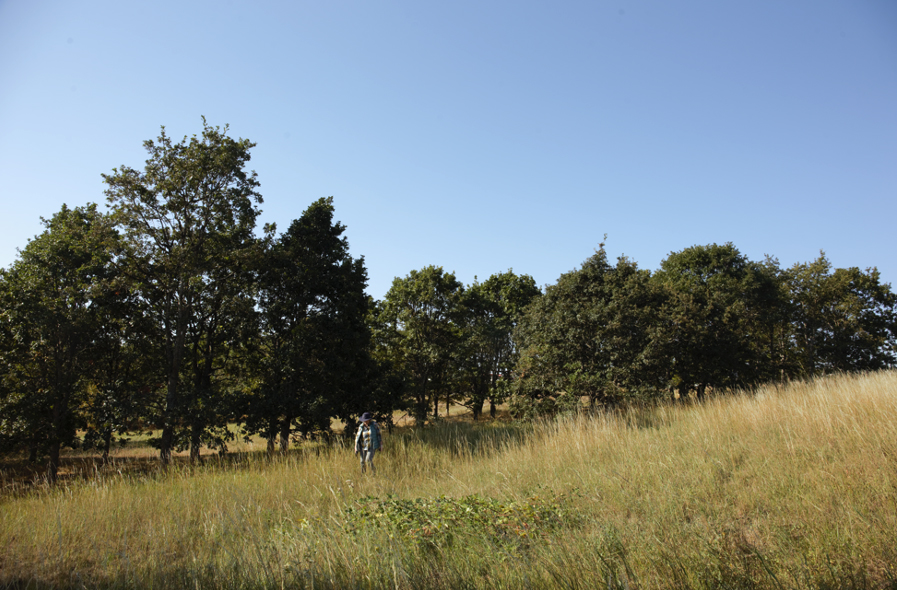
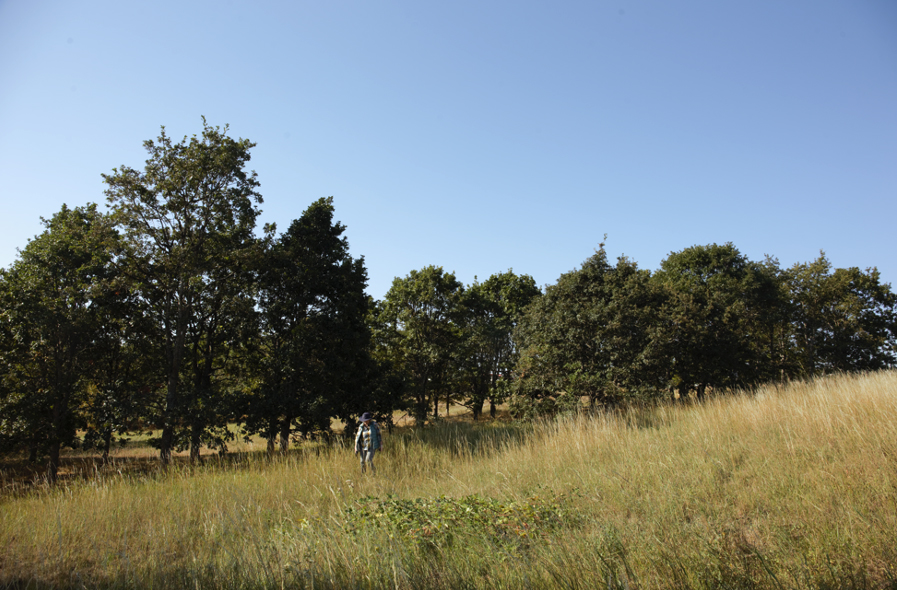
    Quadra Overpass, September 2025, photo by Ryan Senechal.  
    The Bird of Paradise Pub (visible in previous 1995 and 2005 photos) is now obscured by the Garry oak trees that are now just over 30 years old.

    2025 Remeasurement 

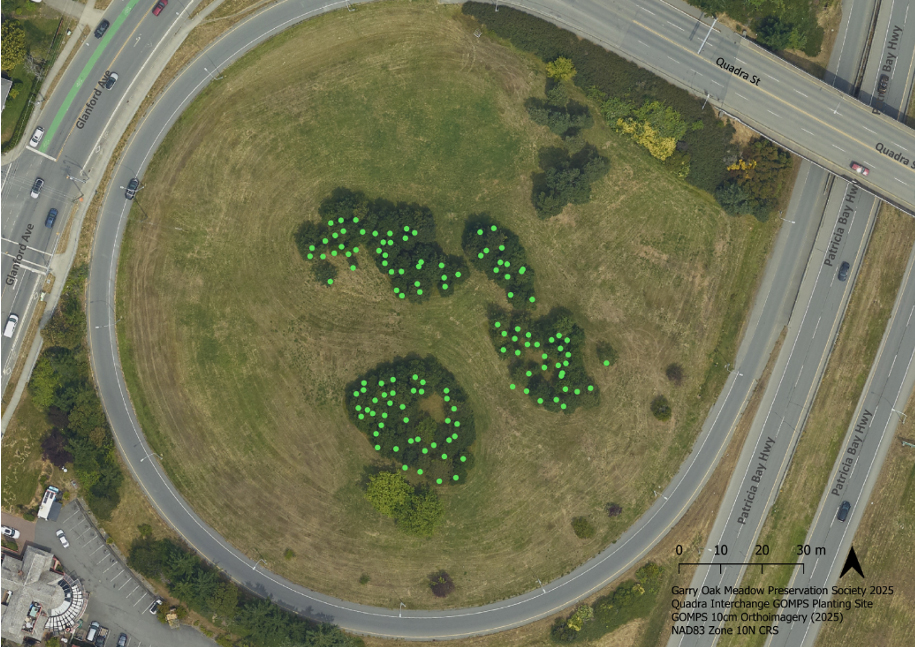
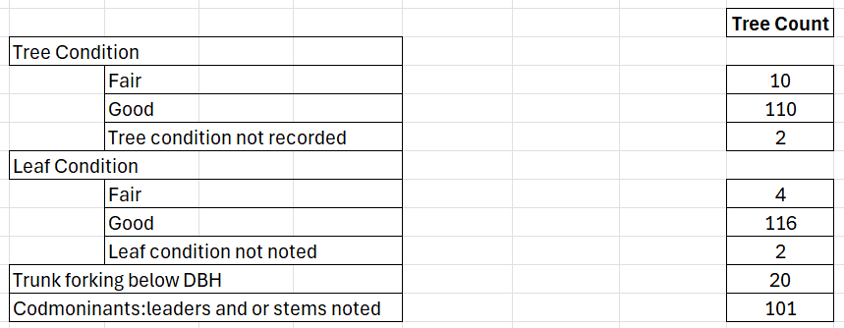
    During September of 2025, two members of GOMPS (Ryan Senechal, President and Jacklyn Jolicoeur, Director visited the plantation site and recorded basic tree inventory statistics for all remaining survivors of the plantation into a mobile application.  The tree data collected included the GPS coordinates, DBH (diameter at breast height), tree height, tree condition, leaf condition, and tree comments.  Here is a comparison summary of the Garry oak tree data over the years.

    Quadra Interchange Sept 3, 2025 Tree Inventory (.pdf)

    Comparison data of Garry oak tree data:
    Data collected in 2025:
    Quadra Overpass, September 2025, photo by Ryan Senechal.  
    The Bird of Paradise Pub (visible in previous 1995 and 2005 photos) is now obscured by the Garry oak trees that are now just over 30 years old.

    Some key takeaways from the assessment

    • Garry oaks require some protection and establishment care to minimize plant mortality.
    • Young tree mortality primarily occurred within the first 10 years of planting.
    • Canopy growth and ring growth rates are slow but faster than estimated in 2006 article).
    • Narrow spacing between Garry oak trees has a considerable effect on understory biodiversity.  These Garry oaks were planted at approximately 3.5 to 4 metres apart. Optimum spacing would be 10 metres.
      • Shrubs and herbaceous species were lacking in the understory.  Multiple stick nests were present, but the species occupying those nests could not be identified.
      • The trees were crowded and crowns overlapped.
    • Acorn collection should take the Garry oak tree form into consideration.  The majority of trees planted demonstrated similar branch architecture.  One defect that consistently appeared was forks with included bark. 

    Future Opportunities – Short Term

    • Resurrect a sign at the Quadra Interchange to acknowledge this legacy tree planting project 
    • Remeasurement of the McKenzie interchange that was also planted in 1994.
    • Introduce stand management to address weak branch unions, improve tree spacing and enhance understory biodiversity.

    Future Opportunities – Long Term

    • Resurrect the vision for the Ministry of Transport (MOT) to improve the local highway landscape with interagency cooperation amongst local governments, GOMPS and others in the volunteer environmental community.  This vision would  pursue enhancement to the large linear greenway along highways with Garry oak tree/meadow plantings to promote biodiversity, climate adapted natural vegetation and create improved driving experience.
    • Extend planting areas and incorporate companion species.  Improve access from Quadra St and incorporate seating.
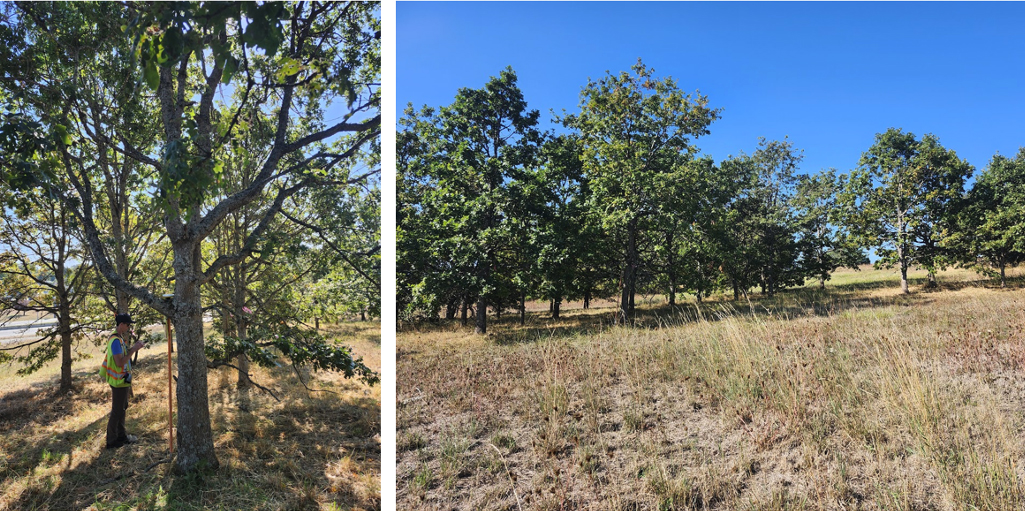
    Quadra Overpass, September 2025, photos by Jacklyn Jolicoeur.  
    Left Picture: Ryan is recording tree data using the mobile app with a GPS locator (see orange pole on the left-hand side of the Garry oak tree).
    Right Picture: The young Garry oak trees
    have an average height of just under 6 metres.

    Sources:

    Jane Waters, Roadside Development Programs, Ministry of Highways and Transportation, “Ministry describes highway replanting program” Garry Oak Meadow Preservation Society Newsletter, Volume 2, Number 8, Page 4, September 1995.

    Pierre d’Estrube, President GOMPS, “The Quadra Overpass Garry Oak Plantation” Garry Oak Meadow Preservation Society Newsletter, Volume 13, Number 1, Page 5, June 2006.
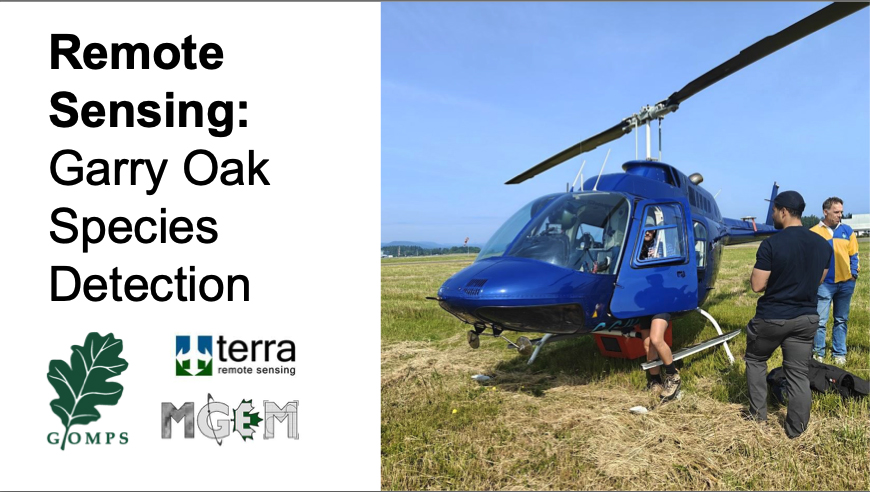
  • Ryan Senechal. Remote Sensing: Garry Oak Species Detection Update, GOMPS AGM, Nov 2025

    Ryan Senechal. Remote Sensing: Garry Oak Species Detection Update, GOMPS AGM, Nov 2025

    GOMPS and Terra Remote Sensing flew to capture LiDAR/ortho on June 24th, 2025

    Table of Contents:

    What for and why now?
    Why GOMPS?
    Why LiDAR?
    Why Victoria and Saanich UCB?
    Project Specifications
    Goals
    What’s Next?

  • Jacklyn Jolicoeur. GOMPS Introduction to Greater Victoria NatureHood, Nov 2025.

    Jacklyn Jolicoeur. GOMPS Introduction to Greater Victoria NatureHood, Nov 2025.

    On November 24, 2025, GOMPS Director Jacklyn Jolicoeur presented to the Greater Victoria NatureHood, a collaborative effort by several not-for-profit, public and private organizations. A list of the partners appears below. Representatives from Nature Canada and Canadian Wildlife Service serve as advisors to the partners.

    GOMPS is now a proud member, and will join the conversation through collaboration in the Greater Victoria region.

    Presentation slides:

  • 2025 Garry Oak Ecosystems Gathering hosted Garry Oak Ecosystem Recovery Team (GOERT)

    2025 Garry Oak Ecosystems Gathering hosted Garry Oak Ecosystem Recovery Team (GOERT)

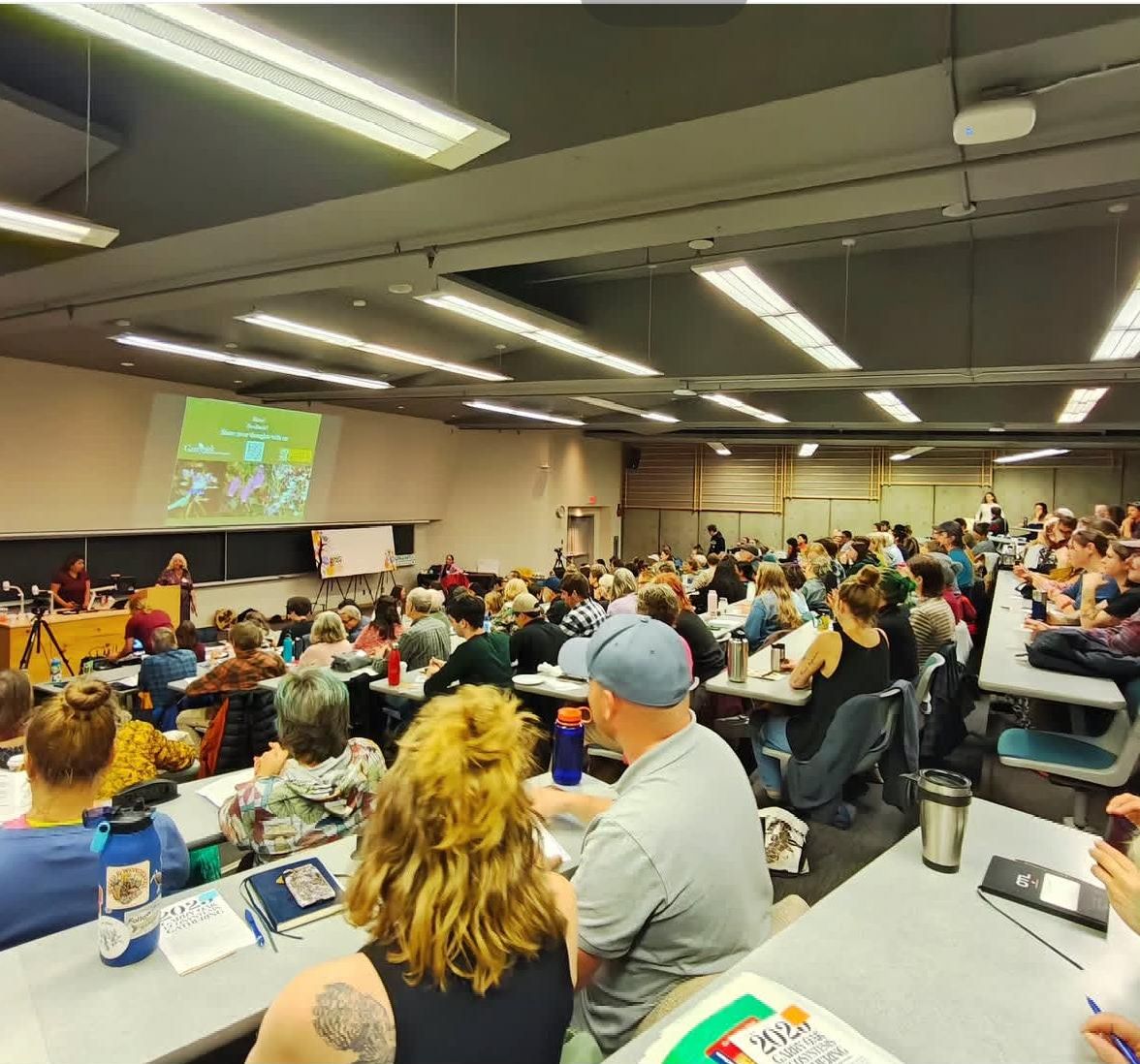
    On November 1st, GOMPS Board members Ryan Senechal, Carollyne Yardley and Jacklyn Jolicoeur participated in the 2025 Garry Oak Ecosystems Gathering at the University of Victoria, hosted by GOERT.  GOMPS provided one of the informational displays available to visitors keen to learn more about the natural environment at our doorstep and the various organizations working to protect and support ecosystem health, especially with so many current threats. Three Garry oak seedlings grown at the nursery were collected for planting. The keynote address was made by Elder SELILIYE Belinda Claxton and Dr. Nancy Turner. With many thanks to the organizers, presenters, and participants. GOMPS looks forward to next year.

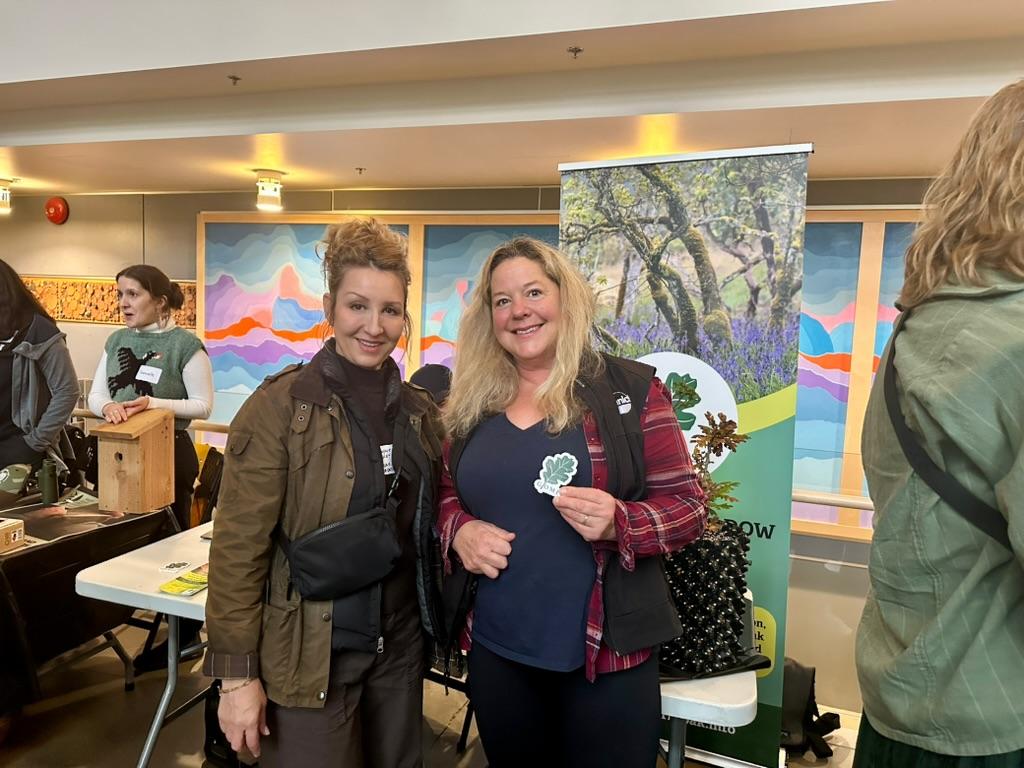
    Photo by Jacklyn Jolicoeur. GOMPS Board member Carollyne Yardley (left) with Saanich Councillor, Nathalie Chambers at the GOMPS informational display.

  • GOMPS Contribution to Rockland Neighbourhood Association OCP Submission

    September 11, 2025
    Advocacy Contributions

    Title:
     GOMPS Contribution to Rockland Neighbourhood Association OCP Submission

    Published by:
    Rockland Neighbourhood Association (RNA)

    Process:
    City of Victoria – Official Community Plan Update

    GOMPS Role:
    GOMPS contributed ecological analysis, Garry oak ecosystem mapping context, and policy recommendations related to urban forest protection and minimum plantable space.

    Context:
    This submission formed part of RNA’s formal response to the City of Victoria’s OCP update and was presented to Council on September 11, 2025.

    Original Publication:

    Rockland Neighbourhood Association OCP Submission 

    – https://pub-victoria.escribemeetings.com/Meeting.aspx?Id=72025c5f-79f4-4abb-8767-77d1996f4eef&Agenda=Merged&lang=English

    https://rockland.bc.ca/wp/wp-content/uploads/2025/10/Public_Hearing_OCP_Sept11_RNA_LUC.pdf

    Contribution:

    URBAN FOREST: CITY-WIDE

    Vancouver Island is located within the Coastal Douglas-fir biogeoclimatic zone. Human pressure from development, agriculture and logging make it the most at-risk biogeoclimatic zone in BC.

    The Kwetlal food system, colonially known as the Garry oak ecosystem, is a subcomponent of this zone and emerged after the glacial retreat around 10,000 years ago. According to the Canadian Forestry Service, the ecosystem is mostly contained to the Metro Victoria area in Canada.

    The open woodland character resulted from millennia of Lekwungen agroecological management and is considered to be a living artifact by the Lekwungen-speaking people. In the absence of these activities, the landscape would be dominated by closed stands of Douglas-fir and Grand fir.

    While relatively intact Garry oak ecosystems can be found in Regional Parks, 75% of Garry oak trees and modified ecosystems are located on what the municipality refers to as private land.

    The Garry oak tree, a long-lived keystone species, supports over 1,645 co-evolved species of plants, insects, mammals, amphibians, birds, and reptiles (that differ from wildland species), making its preservation crucial. Garry oak and associated ecosystems in this region have a unique local genetic adaption that would be difficult to re-introduce if lost.

    Trees exist on private properties in Victoria that exceed 250 years old—the marker which meets the definition of old growth for coastal forests by the Province of BC—and many of those old trees continue to thrive, vibrating with the rich cultural history of the Lekwungen territory.

    Naturally adapted to this region’s severe droughts and heat, native Garry oak trees serve as vital nature-based solutions to counteract flood risks and the urban heat island effect, particularly affecting vulnerable populations.

    Plant ecologist and Indigenous scholar Robin Wall Kimmerer, in her book Braiding Sweetgrass: Indigenous Wisdom, Scientific Knowledge, and the Teachings of Plants, advocates for weaving together Indigenous wisdom and scientific knowledge to help mend the relationship between humans and the natural world.

    The City’s OCP Vision 2050 Reconciliation Actions, Understanding Indigenous Land and Water Management, states that the City will “seek to understand the practices that have supported ecosystem conservation for millennia and work collaboratively to braid Indigenous knowledge systems with Western science in preserving and enhancing natural assets, and in advancing a climate-forward city.”

    The City of Victoria Draft OCP City bylaws, legislation, and process undermine this objective.


    Key Issues

    • The OCP’s new land use class scheme was determined without a City-wide biodiversity assessment on private land, presenting an obstacle to stewardship opportunities.
    • Development Permit Areas for all new housing include requirements for protecting the natural environment, its ecosystem, and biological diversity; however, the General Urban Design guidelines for the urban forest were crafted in the absence of an Indigenous land manager, licensed ecologists, biologists, or urban foresters.
    • Tree Protection Bylaw (21-035) has not been updated since provincial housing legislation directives (2022) and cannot provide physical protection for existing trees located within a proposed building envelope.
    • We are encouraged that the canopy has grown by 100 soccer fields over 10 years while adding more than 8,000 net new homes (almost entirely multifamily buildings). However, the rate of growth dropped by 50% in the last four years, meaning 23 hectares short of the previous four years’ urban tree canopy growth rate.


    Proposed Urban Forest Policy Recommendations

    • Adopt a City-wide Garry oak species detection tool as part of ongoing urban forest remote sensing updates.
    • Create an Urban Forest Technical Advisory group as recommended by the City of Victoria’s Urban Forest Master Plan (2012), with representation from Indigenous knowledge systems, environmental organizations, ecologists, biologists, and urban forestry experts to analyze government and third-party data (such as urban forest remote sensing) and report their recommendations to Parks + Urban Forestry.
    • The OCP reduced Landscape Area (Plantable space) minimums from 9% to 6% on every development lot. Plantable space is a leading indicator of canopy coverage.
    • Therefore, increase the Landscape Area (Plantable space) minimums in Priority Growth and Residential Infill Zoning Areas from 6% to 9%.
    • A 6 m backyard setback (for example) provides limited opportunity to retain existing large trees, and the “Minimum Required Trees Per Lot” is excessively difficult to achieve when applying spacing requirements in the Tree Protection Bylaw.
    • Therefore, increase all setbacks by a minimum of 2 m for Landscape Area (Plantable space) (i.e., soil area for planting a large species of tree as opposed to a medium-sized tree) in the Priority Growth and Residential Infill Zoning Areas.
    • Update Section (4) Applied Guidelines (Pages 189, 193, etc.) from “INTACT Garry oak ecosystems” to “and modified Garry oak ecosystems and Garry oak trees.”

    GOMPS Contribution to Rockland Neighbourhood Association OCP Submission (.pdf)

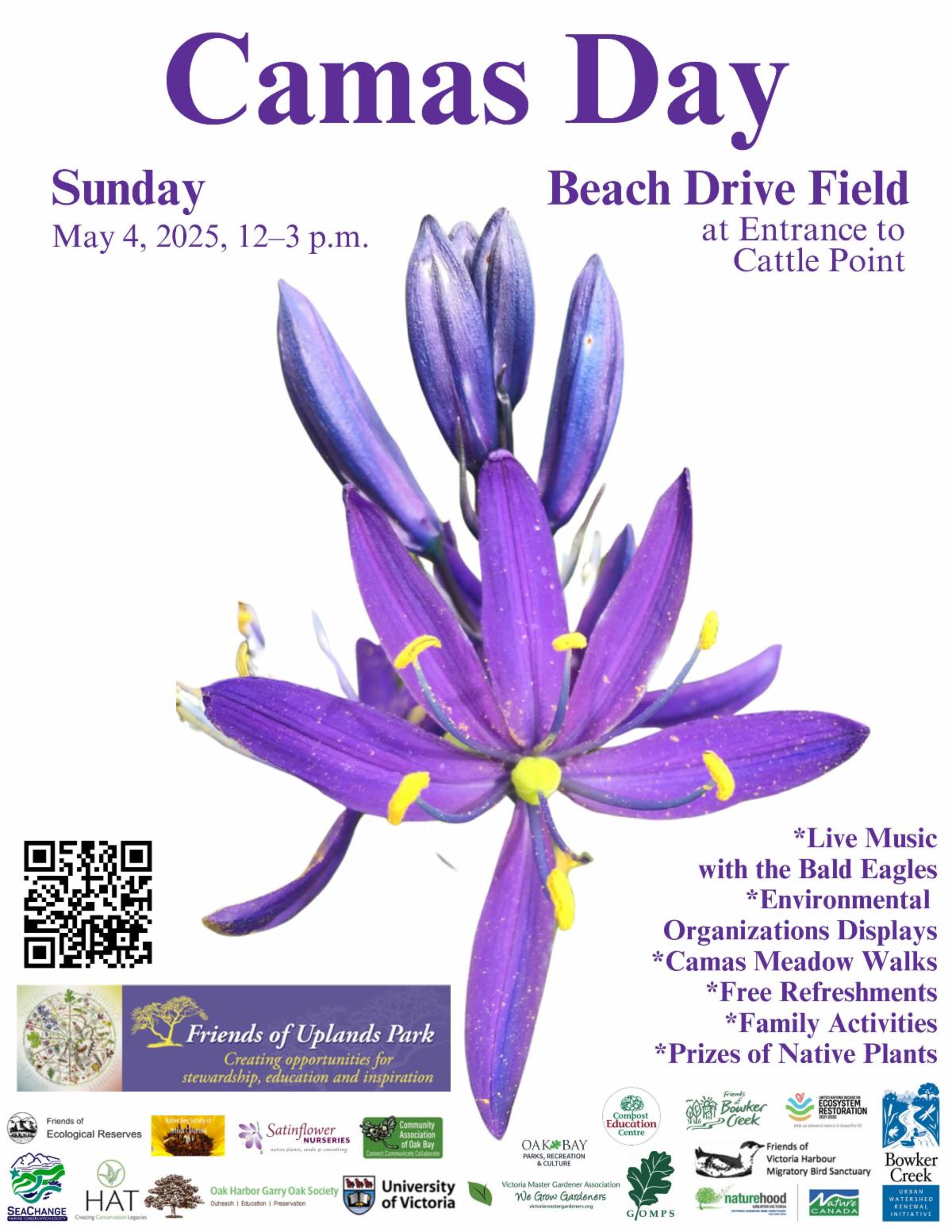
  • Kwetlal (Camas) Day, on Sunday, May 4, from 12 pm to 3 pm.

    Kwetlal (Camas) Day, on Sunday, May 4, from 12 pm to 3 pm.

    Uplands Park, Beach Drive on grassy field at the Cattle Point entrance

    Friends of Uplands Park Society is having its annual celebration. Come by and say hello, enjoy the displays, music, free refreshments, prizes, family activities and Wildflower Meadow Walks of 1 hour will begin at 12:30 pm. 

    More info: https://friendsofuplandspark.org/event/camas-kwetlal-day-sunday-may-4-1200-300pm/

  • Improvement for GOMPS Garry Oak Volunteer Nursery From Nature-based Climate Action Grant – Victoria Foundation

    Improvement for GOMPS Garry Oak Volunteer Nursery From Nature-based Climate Action Grant – Victoria Foundation

    In 2023 GOMPS applied for a Nature-based Climate Action Grant administered by the Victoria Foundation for key infrastructure and maintenance investments for sustainability of the GOMPS Garry Oak Volunteer Nursery.

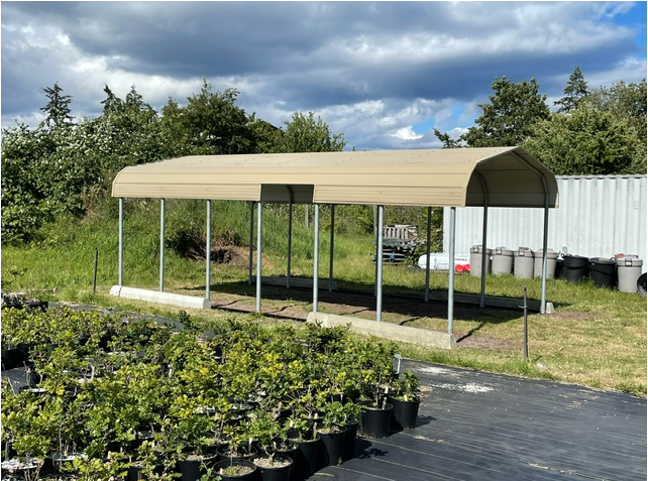
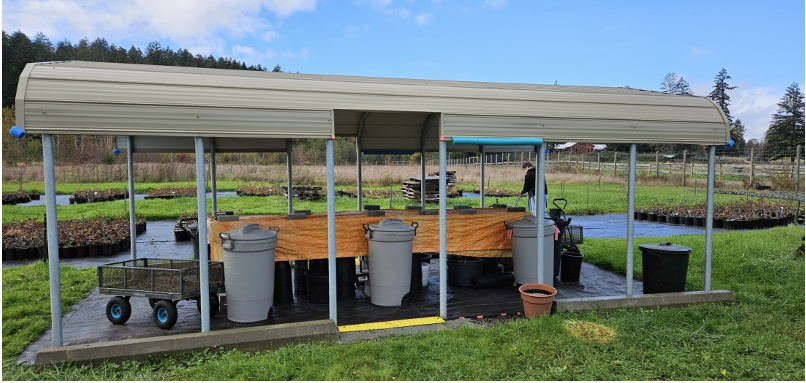
    In 2024 GOMPS received a $13,000 grant to assist with Nursery costs including the erection of a secure and safe work shelter for nursery volunteers having lost 2 previous shelters due to wind, snow & storm damage.

    GOMPS thanks Volunteer Susan Grant who researched shelters, arranged & supervised installation of the shelter and Volunteer Marion Nyberg for making the shelter’s accesses safe for volunteers & visitors.

    The latest Nursery shelter made it through its first winter enabling volunteers to better enjoy the workparties at the Volunteer Nursery!

    Picture by Judith Carder. GOMPS Nursery new work shelter.
  • Seedy Saturday Victoria, on Saturday, February 15, from 11 am – 4 pm. 

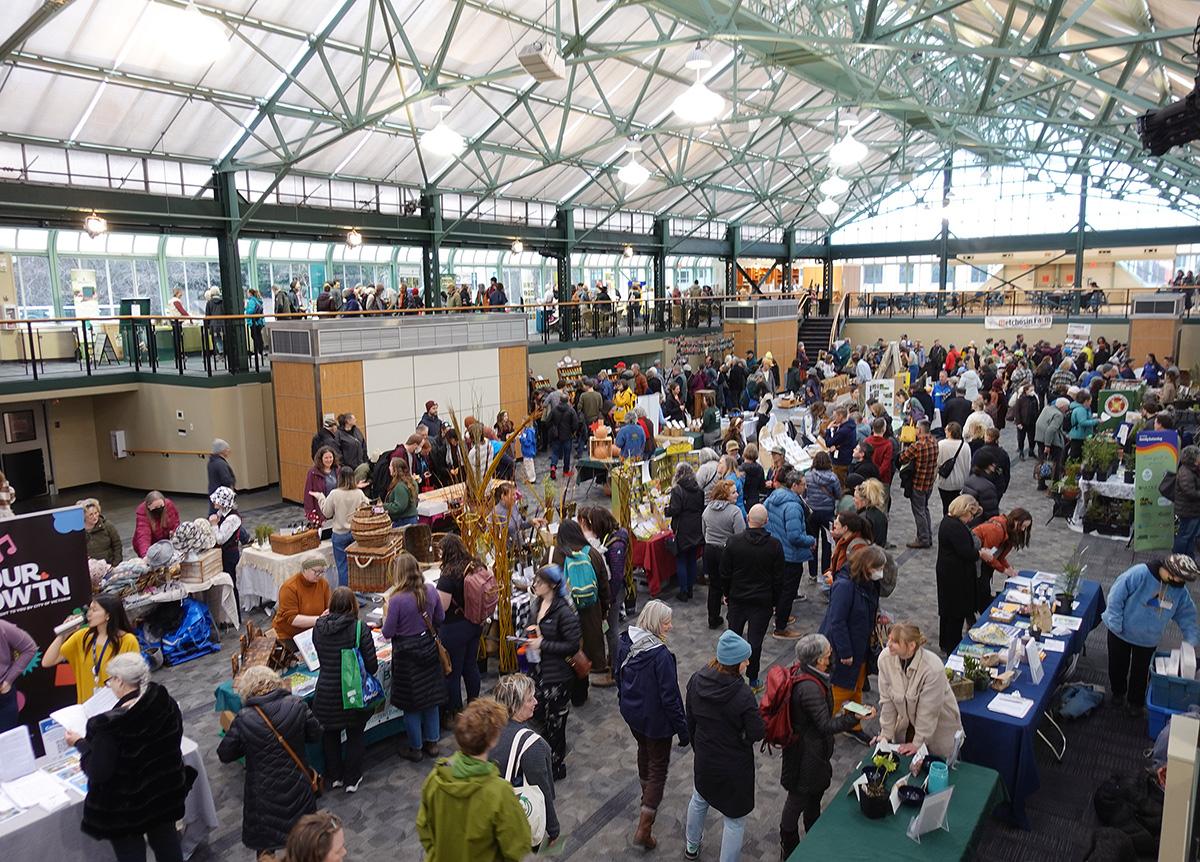
    Seedy Saturday Victoria, on Saturday, February 15, from 11 am – 4 pm. 

    On February 15th GOMPS Directors and Members set up a booth to join over 50+ incredible vendors for Seedy Saturday this year! From seeds, plants, and garden supplies to non-profits and more. Thanks to all the visitors who came by to say hello, and signed up for our Enews!

Categories

Archives