News

  • Jacklyn Jolicoeur. GOMPS Introduction to Greater Victoria NatureHood, Nov 2025.

    Jacklyn Jolicoeur. GOMPS Introduction to Greater Victoria NatureHood, Nov 2025.

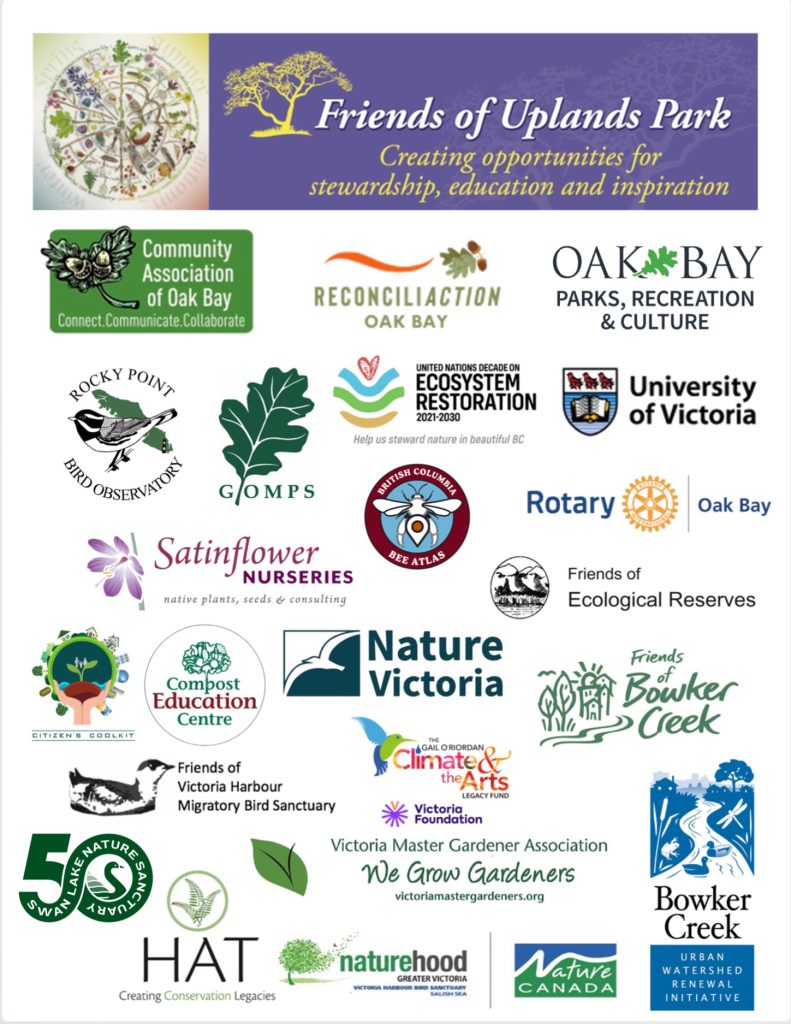
    On November 24, 2025, GOMPS Director Jacklyn Jolicoeur presented to the Greater Victoria NatureHood, a collaborative effort by several not-for-profit, public and private organizations. A list of the partners appears below. Representatives from Nature Canada and Canadian Wildlife Service serve as advisors to the partners.

    GOMPS is now a proud member, and will join the conversation through collaboration in the Greater Victoria region.

    Presentation slides:

  • GOMPS. “Letter to Oak Bay Municipality Council,” Agenda Item #7.3, Uplands Siting and Design (ADP00192) 2830-2850 Lansdowne Road, Nov 24, 2024.

    Garry Oak Meadow Preservation Society. “Letter to Oak Bay Municipality Council,” Nov 24, 2024. Agenda Item #7.3, Uplands Siting and Design (ADP00192) 2830-2850 Lansdowne Road.

  • Jacklyn Jolicoeur. Nursery and Planted Garry Oak Monitoring Activity Report for AGM, Nov 2025.

  • Jeff Bell. Donated acorns help society produce Garry oak crop, Times Colonist. Oct 26, 2025.

    Times Colonist. Donated acorns help society produce Garry oak crop. Oct 2025.
    https://www.timescolonist.com/life/donated-acorns-help-society-produce-garry-oak-crop-11390955
    jbell@timescolonist.com

    A $13,000 grant from the Victoria Foundation to help preserve the trees in the group’s nursery is a major boost

    Acorns collected by the public are being planted to produce more Garry oaks as proponents work to strengthen the depleted tree species.

    Arborist and society president of the Garry Oak Meadow Preservation Society Ryan Senechal said a $13,000 grant from the Victoria Foundation to help preserve the trees in the group’s nursery is a major boost.

    The nursery is on Capital Regional District-owned land off the Pat Bay Highway just north of Sayward Road, and it has now been able to purchase a shelter where volunteers can work on the plants, Senechal said.

    The site used to be the location of the City of Victoria’s tree nursery, he said, so the group entered into a partnership with the city to take over the use of the property.

    Getting enough acorns to plant is “a community participatory project” that sees the society reaching out via its website, local media and social media for acorn donations, Senechal said.

    He said the society has been “overwhelmed” with the amount of acorns gathered this year, so no more are needed for now.

    The trees that can grow are from acorns that were “100 per cent” provided by community members, Senechal said.

    That fits with the society’s focus on producing the “local ecotype” of Garry oaks to distribute around the region, he said, and added the society is “interested in stewarding the local population.”

    The annual request for acorn donations comes in early September.

    Guidelines for the public include testing the acorns to see if they float, since acorns that float can’t be used.

    Also unsuitable are acorns with caps, which indicate that they aren’t ripe.

    Senechal said many of the acorns received have already started root growth, and some will emerge at the potting stage, while some will not.

    Once planted, the successful acorns take root and establish a small stem and leaves.

    He pointed to a 2006 study on Garry oak ecosystems that looked at their historical range on Vancouver Island and beyond, with the conclusion being that less than five per cent of the original range remained in Canada.

    That number refers to areas that are “relatively intact,” and it falls to three per cent for areas in prime condition, he said — making Canada’s Garry oak ecosystems “critically endangered.”

    Senchal said the Garry Oak Meadow Preservation Society was formed in 1992, a time when there was little in the way of tree-protection bylaws to manage urban forests.

    Its society members spent considerable time advocating for the sort of protections we see more of today.

    He said the “latest dilemma” for the society is the continuing fragmentation of remaining Garry oak ecosystems, and trees that are vulnerable due to the push for added space for housing in the region.

    This leaves them having to “constantly evolve as an advocacy organization.”

    The society website is at garryoak.info.

  • GOMPS Contribution to Rockland Neighbourhood Association OCP Submission

    September 11, 2025
    Advocacy Contributions

    Title:
     GOMPS Contribution to Rockland Neighbourhood Association OCP Submission

    Published by:
    Rockland Neighbourhood Association (RNA)

    Process:
    City of Victoria – Official Community Plan Update

    GOMPS Role:
    GOMPS contributed ecological analysis, Garry oak ecosystem mapping context, and policy recommendations related to urban forest protection and minimum plantable space.

    Context:
    This submission formed part of RNA’s formal response to the City of Victoria’s OCP update and was presented to Council on September 11, 2025.

    Original Publication:

    Rockland Neighbourhood Association OCP Submission 

    – https://pub-victoria.escribemeetings.com/Meeting.aspx?Id=72025c5f-79f4-4abb-8767-77d1996f4eef&Agenda=Merged&lang=English

    https://rockland.bc.ca/wp/wp-content/uploads/2025/10/Public_Hearing_OCP_Sept11_RNA_LUC.pdf

    Contribution:

    URBAN FOREST: CITY-WIDE

    Vancouver Island is located within the Coastal Douglas-fir biogeoclimatic zone. Human pressure from development, agriculture and logging make it the most at-risk biogeoclimatic zone in BC.

    The Kwetlal food system, colonially known as the Garry oak ecosystem, is a subcomponent of this zone and emerged after the glacial retreat around 10,000 years ago. According to the Canadian Forestry Service, the ecosystem is mostly contained to the Metro Victoria area in Canada.

    The open woodland character resulted from millennia of Lekwungen agroecological management and is considered to be a living artifact by the Lekwungen-speaking people. In the absence of these activities, the landscape would be dominated by closed stands of Douglas-fir and Grand fir.

    While relatively intact Garry oak ecosystems can be found in Regional Parks, 75% of Garry oak trees and modified ecosystems are located on what the municipality refers to as private land.

    The Garry oak tree, a long-lived keystone species, supports over 1,645 co-evolved species of plants, insects, mammals, amphibians, birds, and reptiles (that differ from wildland species), making its preservation crucial. Garry oak and associated ecosystems in this region have a unique local genetic adaption that would be difficult to re-introduce if lost.

    Trees exist on private properties in Victoria that exceed 250 years old—the marker which meets the definition of old growth for coastal forests by the Province of BC—and many of those old trees continue to thrive, vibrating with the rich cultural history of the Lekwungen territory.

    Naturally adapted to this region’s severe droughts and heat, native Garry oak trees serve as vital nature-based solutions to counteract flood risks and the urban heat island effect, particularly affecting vulnerable populations.

    Plant ecologist and Indigenous scholar Robin Wall Kimmerer, in her book Braiding Sweetgrass: Indigenous Wisdom, Scientific Knowledge, and the Teachings of Plants, advocates for weaving together Indigenous wisdom and scientific knowledge to help mend the relationship between humans and the natural world.

    The City’s OCP Vision 2050 Reconciliation Actions, Understanding Indigenous Land and Water Management, states that the City will “seek to understand the practices that have supported ecosystem conservation for millennia and work collaboratively to braid Indigenous knowledge systems with Western science in preserving and enhancing natural assets, and in advancing a climate-forward city.”

    The City of Victoria Draft OCP City bylaws, legislation, and process undermine this objective.


    Key Issues

    • The OCP’s new land use class scheme was determined without a City-wide biodiversity assessment on private land, presenting an obstacle to stewardship opportunities.
    • Development Permit Areas for all new housing include requirements for protecting the natural environment, its ecosystem, and biological diversity; however, the General Urban Design guidelines for the urban forest were crafted in the absence of an Indigenous land manager, licensed ecologists, biologists, or urban foresters.
    • Tree Protection Bylaw (21-035) has not been updated since provincial housing legislation directives (2022) and cannot provide physical protection for existing trees located within a proposed building envelope.
    • We are encouraged that the canopy has grown by 100 soccer fields over 10 years while adding more than 8,000 net new homes (almost entirely multifamily buildings). However, the rate of growth dropped by 50% in the last four years, meaning 23 hectares short of the previous four years’ urban tree canopy growth rate.


    Proposed Urban Forest Policy Recommendations

    • Adopt a City-wide Garry oak species detection tool as part of ongoing urban forest remote sensing updates.
    • Create an Urban Forest Technical Advisory group as recommended by the City of Victoria’s Urban Forest Master Plan (2012), with representation from Indigenous knowledge systems, environmental organizations, ecologists, biologists, and urban forestry experts to analyze government and third-party data (such as urban forest remote sensing) and report their recommendations to Parks + Urban Forestry.
    • The OCP reduced Landscape Area (Plantable space) minimums from 9% to 6% on every development lot. Plantable space is a leading indicator of canopy coverage.
    • Therefore, increase the Landscape Area (Plantable space) minimums in Priority Growth and Residential Infill Zoning Areas from 6% to 9%.
    • A 6 m backyard setback (for example) provides limited opportunity to retain existing large trees, and the “Minimum Required Trees Per Lot” is excessively difficult to achieve when applying spacing requirements in the Tree Protection Bylaw.
    • Therefore, increase all setbacks by a minimum of 2 m for Landscape Area (Plantable space) (i.e., soil area for planting a large species of tree as opposed to a medium-sized tree) in the Priority Growth and Residential Infill Zoning Areas.
    • Update Section (4) Applied Guidelines (Pages 189, 193, etc.) from “INTACT Garry oak ecosystems” to “and modified Garry oak ecosystems and Garry oak trees.”

    GOMPS Contribution to Rockland Neighbourhood Association OCP Submission (.pdf)

  • Ryan Senechal. Urban Forest, City of Victoria OCP Public Hearing, Sept 11 2025.

  • Summer/Fall (September) 2025 Newsletter

    Garry Oak Leaflet Summer/Fall 2025 (PDF)

  • Community Event / Spring Lecture: The Urban Forest in Saanich – Strategy and Stewardship

    The Camosun Community Associations presents a free lecture in partnership with the Mount Tolmie Community Association, featuring guest speaker, Ryan Senechal.
    Ryan Senechal is an educator and a practicing consulting arborist/ urban forester with experience across municipal, commercial, education and nonprofit sectors. He is a lecturer in the Bachelor of Urban Forestry and Master of Urban Forestry Leadership programs at University of British Columbia’s Faculty of Forestry. 

    Speaker: Ryan Senechal
    When: Wednesday, May 7th
    Time: Doors open at 6:45 pm – Lecture 7-9 pm – includes Q&A
    Where: Broad View United Church – 3703 St. Aidan’s St. (enter at lower level at back of church)Cookies, coffee and tea will be provided.
    You may read online about Ryan to get a notion of what keeps him active locally using these links:

    Spring Lecture: "The Urban Forest in Saanich: Strategy & Stewardship"
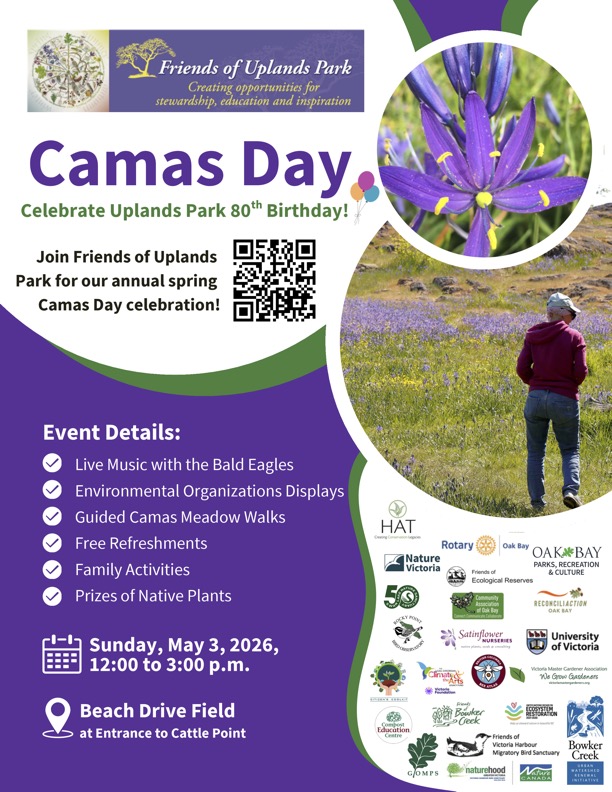
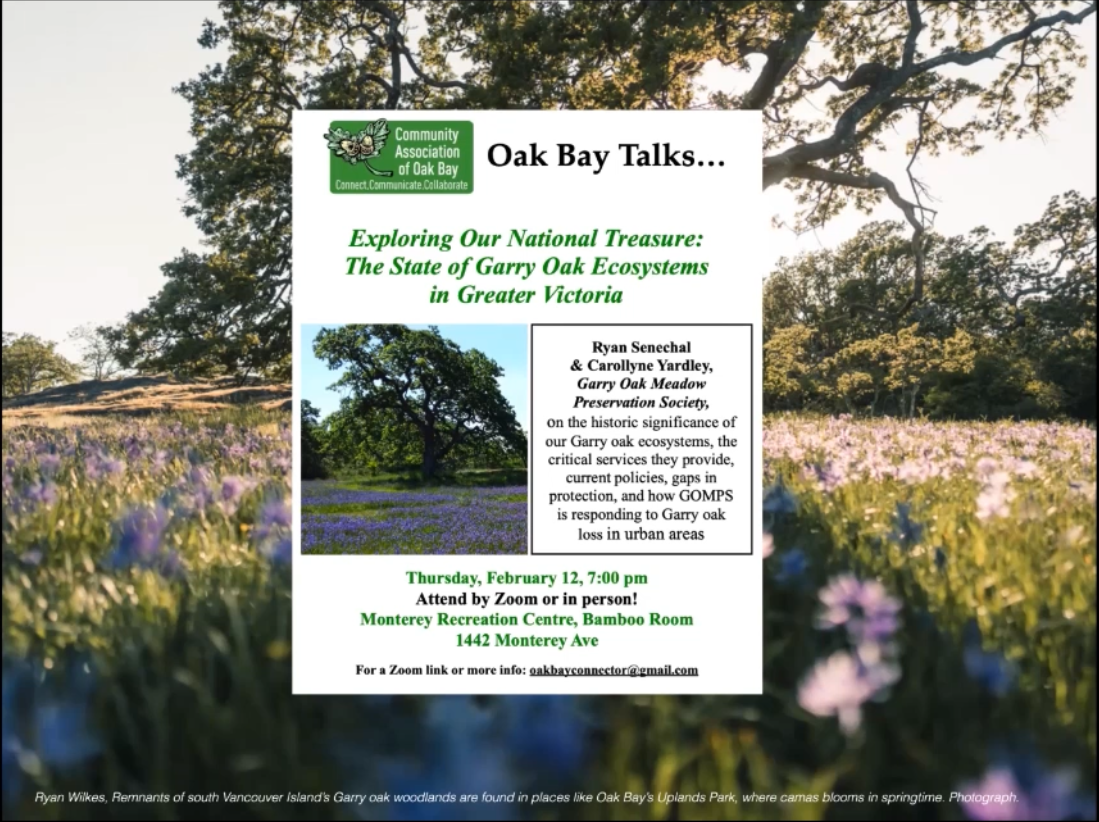
  • Kwetlal (Camas) Day, on Sunday, May 4, from 12 pm to 3 pm.

    Kwetlal (Camas) Day, on Sunday, May 4, from 12 pm to 3 pm.

    Uplands Park, Beach Drive on grassy field at the Cattle Point entrance

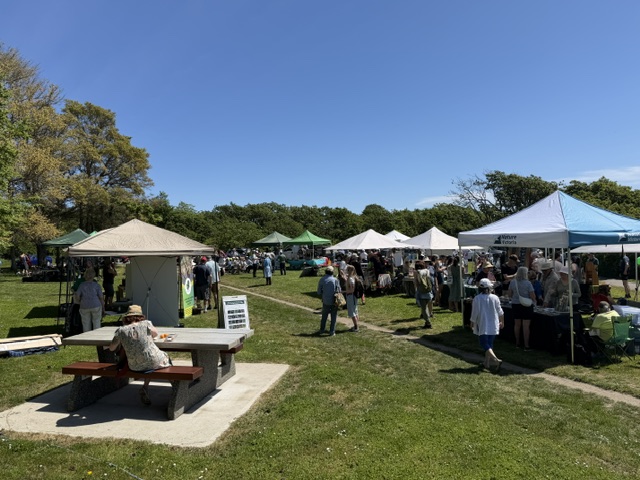
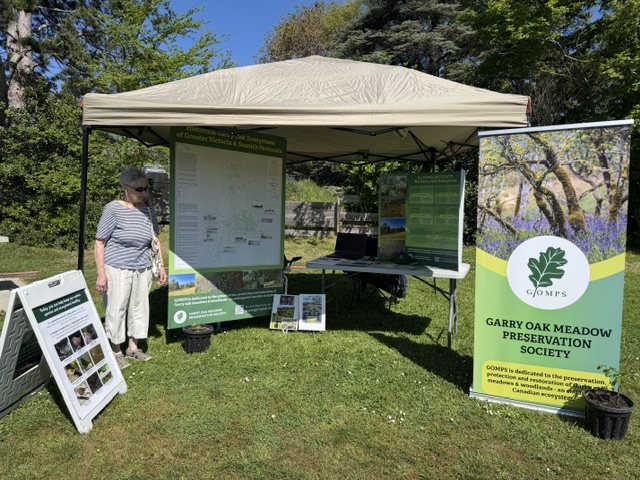
    Friends of Uplands Park Society is having its annual celebration. Come by and say hello, enjoy the displays, music, free refreshments, prizes, family activities and Wildflower Meadow Walks of 1 hour will begin at 12:30 pm. 

    More info: https://friendsofuplandspark.org/event/camas-kwetlal-day-sunday-may-4-1200-300pm/

  • Improvement for GOMPS Garry Oak Volunteer Nursery From Nature-based Climate Action Grant – Victoria Foundation

    Improvement for GOMPS Garry Oak Volunteer Nursery From Nature-based Climate Action Grant – Victoria Foundation

    In 2023 GOMPS applied for a Nature-based Climate Action Grant administered by the Victoria Foundation for key infrastructure and maintenance investments for sustainability of the GOMPS Garry Oak Volunteer Nursery.

    In 2024 GOMPS received a $13,000 grant to assist with Nursery costs including the erection of a secure and safe work shelter for nursery volunteers having lost 2 previous shelters due to wind, snow & storm damage.

    GOMPS thanks Volunteer Susan Grant who researched shelters, arranged & supervised installation of the shelter and Volunteer Marion Nyberg for making the shelter’s accesses safe for volunteers & visitors.

    The latest Nursery shelter made it through its first winter enabling volunteers to better enjoy the workparties at the Volunteer Nursery!

    Picture by Judith Carder. GOMPS Nursery new work shelter.

Categories

Archives